 CONNECT THE VIRTUAL WORLD
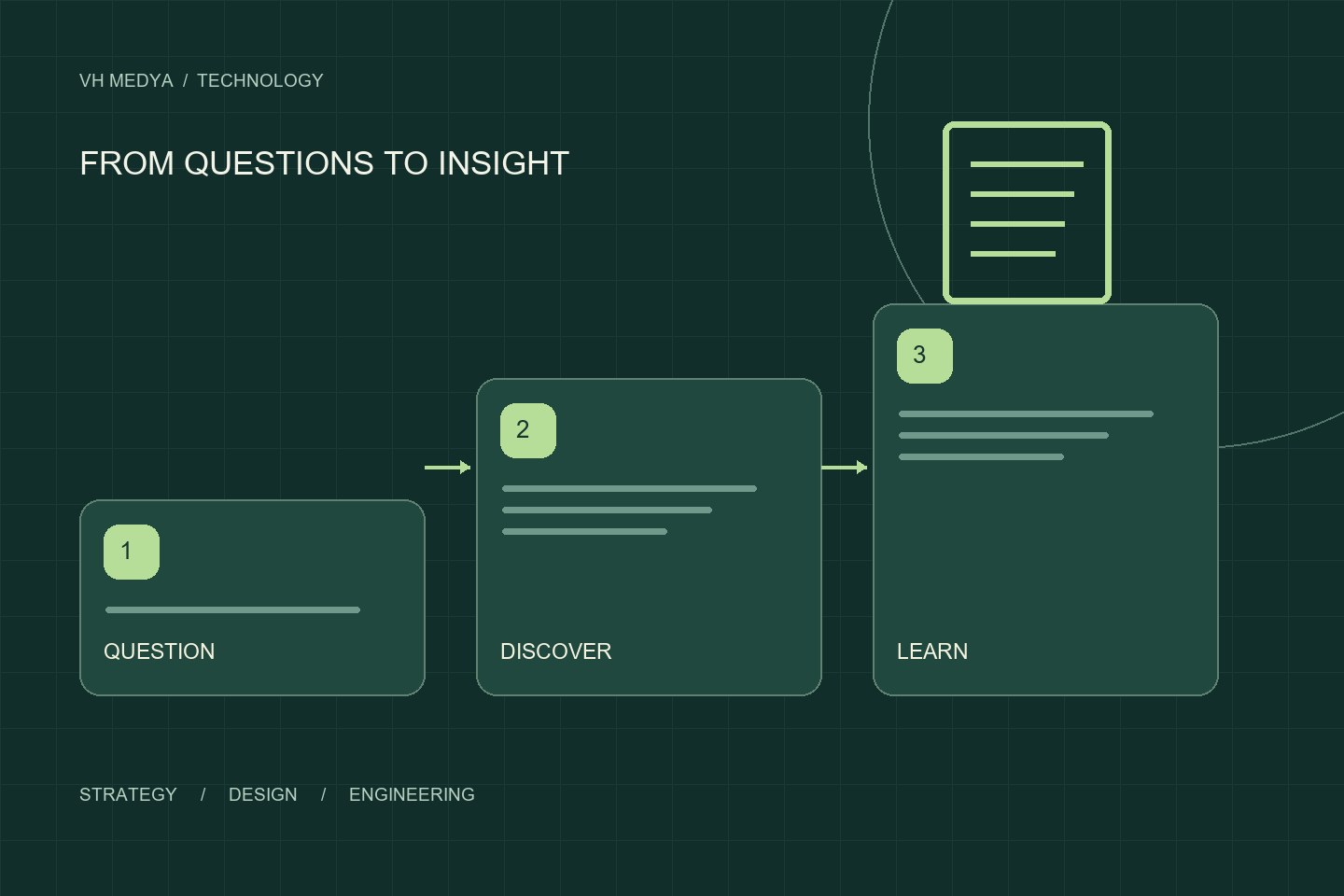
Search intent and keyword strategy investigates how customers describe a need and what information they expect to find. VH Medya translates that evidence into service architecture, content briefs and prioritised actions. The work is broader than collecting a long list of phrases. The expression G.L.M. used on the existing website is treated as an internal description of this learning process, not as an official Google programme or a method for training its ranking algorithm.
Connect customer language with the service offer
A company may describe its work using technical terminology while a prospective customer describes an operational problem. A team providing API integration might receive a question such as “why does inventory differ between my two shops?” Both expressions can belong to the same journey. Sales questions, available on-site searches, Search Console queries and relevant public sources help identify those connections. Personal information is not unnecessarily transferred into research or public content.
Collected phrases are grouped by purpose: selecting a provider, comparing approaches, solving a problem or learning the basics. Similar needs usually belong together rather than each receiving a separate landing page. Search volume is not invented where an appropriate source is unavailable. Seasonal changes, branded searches and general industry questions are distinguished. Research dates and source limitations are recorded so later reviews can compare evidence on a reasonably consistent basis.
Turn the research into a topic map
A useful topic map shows the relationship between a principal service, supporting guides and related questions. The service page explains scope and delivery to someone assessing a provider. A guide answers a narrower question in more depth. If several existing pages give essentially the same answer, consolidation or clearer differentiation may be more appropriate than publishing another similar article. The purpose of a page should be understood before changing only its title or length.
Content briefs specify the audience, main question, evidence requirements, suggested sections and relevant internal links. Turkish and English research is not reduced to word-for-word translation. English-speaking customers may use different terminology and compare providers differently. Without a defined regional market, a particular country's demand or vocabulary should not be assumed. Location pages also need real service coverage and useful local information rather than a place name inserted into an otherwise repeated template.
Connect learning with implementation
The resulting work is prioritised by business relevance, existing visibility, missing information and implementation effort. The next useful action may be improving a service page that already receives impressions, rather than writing a new article. In another case, buyers may need a practical comparison before they can decide. Research becomes valuable when it explains which page should change, what information is missing and how the improvement will be assessed.
For example, someone commissioning a corporate website may ask about cost factors, preparing content and preserving existing URLs. A service page can answer those concerns concisely and link to a detailed migration guide. After publication, impressions for relevant query groups and qualified enquiries are reviewed. New evidence feeds back into the topic map. The first research document remains a working hypothesis that develops with actual customer behaviour, not a permanent statement of demand.
Scope, delivery and next steps
The initial discussion establishes the business need, existing systems and intended outcome. Included work, access dependencies and the information or approvals required from the client are recorded clearly. The proposal considers responsibility for updates and maintenance alongside the first delivery. This gives everyone a shared understanding of what will be assessed and when a deliverable can reasonably be considered complete.
Implementation is divided into manageable steps with practical acceptance criteria. Each result is checked through a realistic usage scenario. Missing access or unavailable data is recorded as a limitation rather than presented as a measured outcome. Delivery distinguishes the action taken, the evidence observed and any remaining verification. Further improvements are prioritised by value, effort and dependencies. To discuss your project, share your website, the service that matters most and the problem you want to resolve. Private credentials do not need to be included in the initial message; an appropriate access method can be arranged within the agreed scope.