 CONNECT THE VIRTUAL WORLD
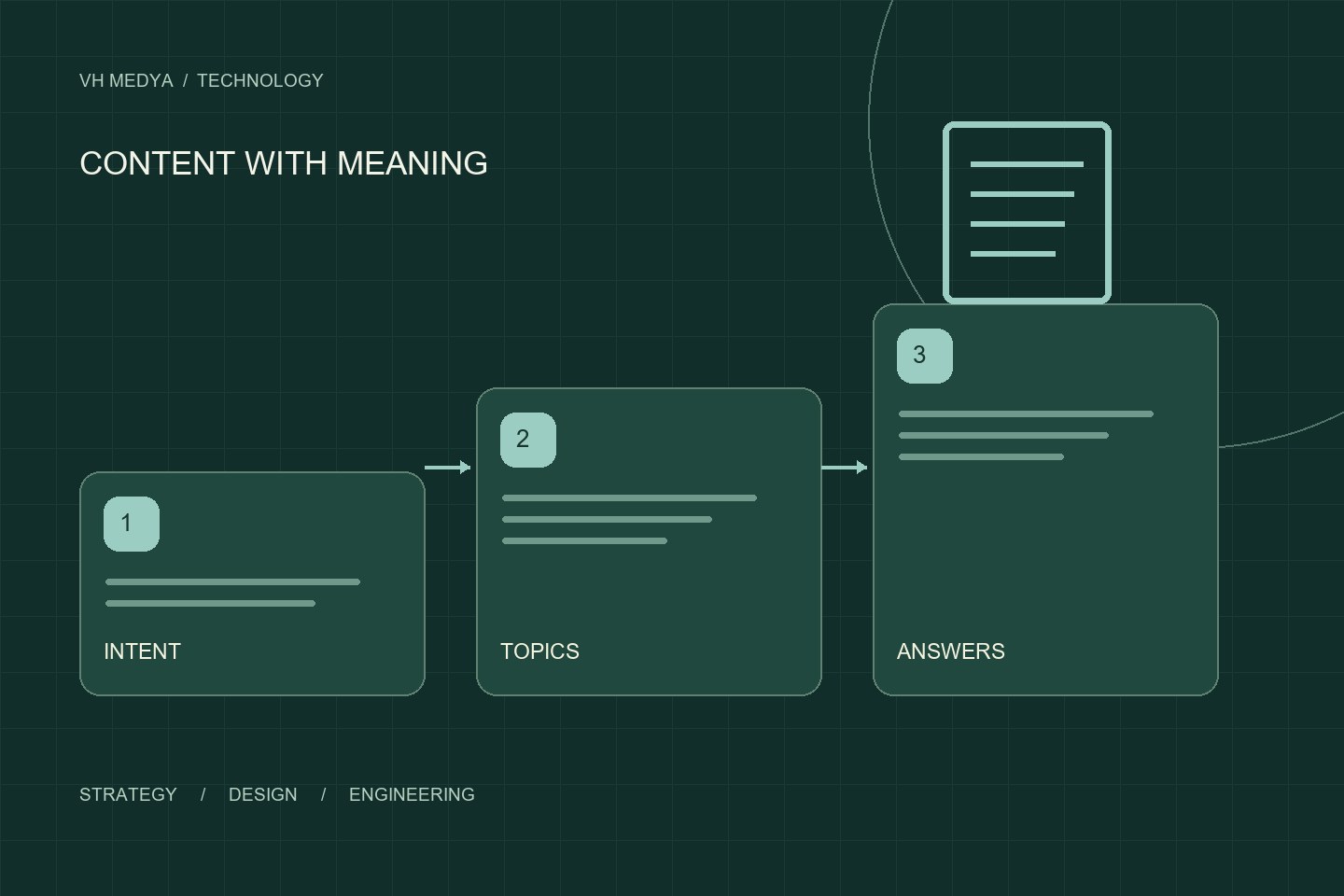
Semantic content explains a subject through related questions, concepts and practical context rather than repeated keywords. VH Medya plans service pages, category explanations and guides around search intent and a coherent site structure. Publishing automation organises preparation, review and release. Automated drafting does not remove responsibility for accuracy, usefulness or editorial approval, and a larger volume of pages is not automatically a better outcome.
Give each piece a clear job
The intended reader and central question are defined before drafting. A service page explains scope, delivery, outputs and buying considerations. An article can explore a narrower problem in more detail. Separating those roles produces a useful topic cluster instead of several pages offering essentially the same answer. Content gaps are assessed through customer questions, available query evidence and the information people need to make a decision.
Coverage develops through relevant terminology, process explanations, selection criteria and genuine questions. Word count alone does not establish quality. A long page that repeats one idea offers little additional help. Concise summaries, original examples and suitable comparisons may make the information more usable. Industry terms should clarify the subject, not be inserted simply to make the text look technically sophisticated or to satisfy an arbitrary repetition target.
Verify sources and adapt both languages
Statistics, technical claims and statements involving regulations require suitable verification. Where a real customer project is described, permission and data boundaries need review. Hypothetical scenarios remain clearly distinguishable from achieved results. The person or organisation responsible for the content should be identifiable. Genuine specialist contributions can strengthen an explanation; qualifications and experience are not invented. Changing information needs an owner and a reasonable review process.
Turkish and English versions should serve the same purpose through natural language. Terminology, reader knowledge and buying expectations may differ. Localisation involves more than translating the heading while leaving the rest of the experience unchanged. Equivalent pages need appropriate links, their own canonical URLs and accurate language information. When one version changes materially, the other version's currency should also be reviewed rather than allowed to drift unnoticed.
Use automation within an editorial workflow
Research, drafting, editing, specialist review and publication can be separate states. Automation may help create assignments, transfer approved content or check missing fields. Publishing large numbers of unchecked drafts does not establish quality. Titles, descriptions, internal links, image rights and factual claims are reviewed before release. A page's update date should reflect a meaningful change, not merely the fact that a scheduled script has run again.
For example, an inventory integration service can be supported by a guide explaining why stock quantities differ between two systems. The guide links naturally to the relevant service, while the service page offers the guide to readers who need a deeper explanation. After publication, the address, mobile presentation and search accessibility are verified. Queries and customer feedback inform subsequent improvements. The goal is a trustworthy answer to each important customer question, with a maintainable publishing process that supports continued accuracy rather than unchecked production.
Scope, delivery and next steps
The initial discussion establishes the business need, existing systems and intended outcome. Included work, access dependencies and the information or approvals required from the client are recorded clearly. The proposal considers responsibility for updates and maintenance alongside the first delivery. This gives everyone a shared understanding of what will be assessed and when a deliverable can reasonably be considered complete.
Implementation is divided into manageable steps with practical acceptance criteria. Each result is checked through a realistic usage scenario. Missing access or unavailable data is recorded as a limitation rather than presented as a measured outcome. Delivery distinguishes the action taken, the evidence observed and any remaining verification. Further improvements are prioritised by value, effort and dependencies. To discuss your project, share your website, the service that matters most and the problem you want to resolve. Private credentials do not need to be included in the initial message; an appropriate access method can be arranged within the agreed scope.