 CONNECT THE VIRTUAL WORLD
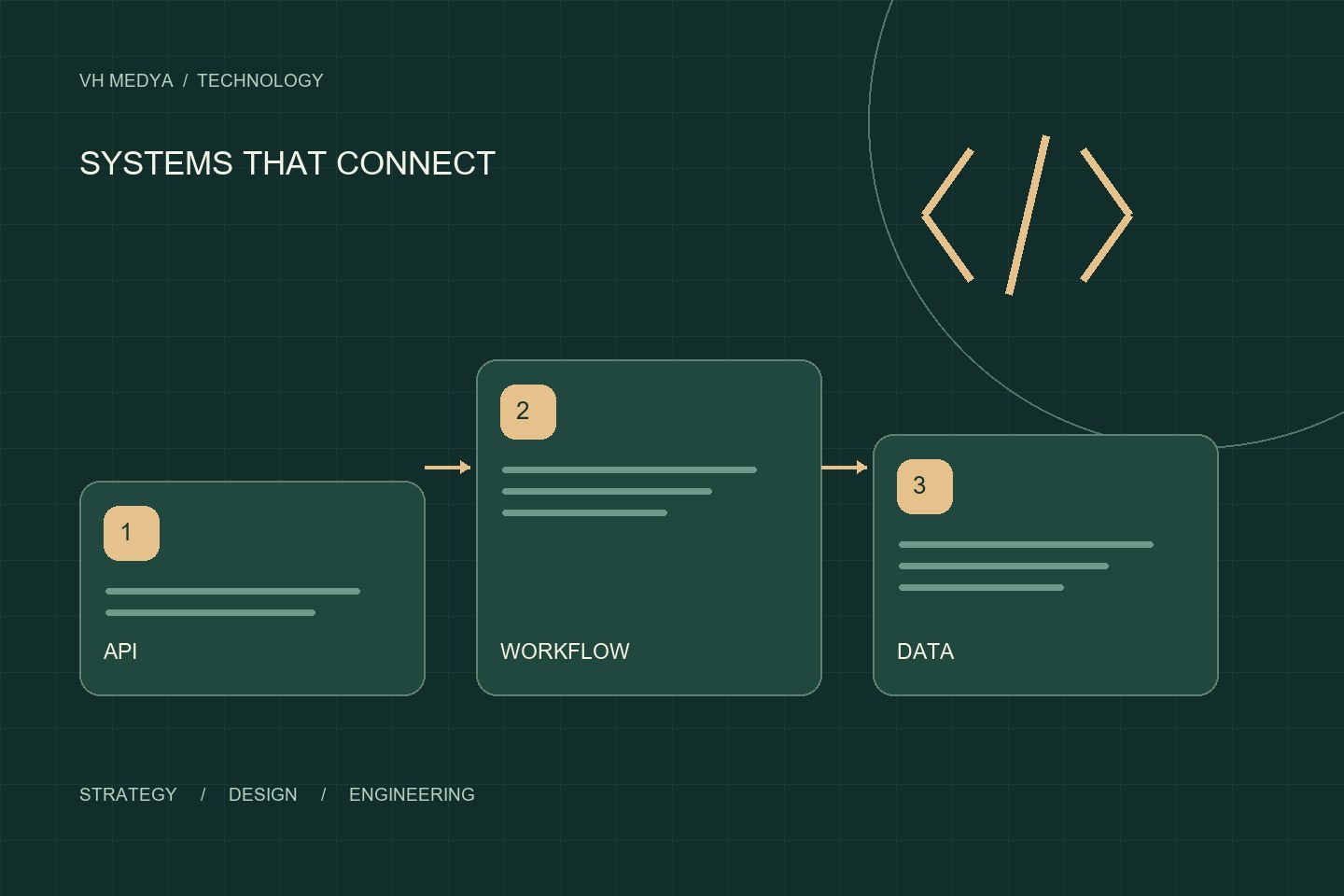
Custom software turns an organisation's working process into a system that people can use reliably. Inventory, catalogues, customer records and approval flows may need capabilities that an existing tool does not provide. VH Medya starts with the operational requirement rather than a preferred technology stack. The objective is to reduce repetitive work while maintaining accurate data, clear responsibility and a record of what happened.
Define the process and data relationships
Discovery follows the people who perform the work. Who enters a record, who approves it, which information moves to another system and where do errors occur? Requirements are separated into essential functions and later improvements. This keeps the first release focused instead of trying to solve every possible future problem. Screen prototypes are reviewed against realistic sample records, including unusual cases rather than only the easiest path.
Inventory software needs explicit relationships between products, warehouses, variants, units and movement types. Recording only a current quantity may be insufficient when the business needs to understand receipts, sales, returns and corrections. Simultaneous updates, negative stock and repeated operations require defined behaviour. Identifiers must map consistently to the accounting or e-commerce system, and a change to a product code should not silently break the history of earlier transactions.
Design integrations for failure as well as success
API integrations need a documented field mapping, transfer frequency and error policy. Not every update has to happen instantly; queues or scheduled tasks may provide a more reliable fit for some workflows. If a connection fails, transactions should remain recoverable. A retry should not create the same operation twice, and a responsible person needs a useful way to identify and resolve the problem. External service limits and supported methods are included in the design.
Access is assigned by role. An administrator, an operations employee and a customer should not automatically see the same records. Session security, activity logs and backup requirements are considered alongside the user interface. Sensitive records require actual access control, rather than an obscure public URL or a robots rule. Integrations should transfer only the personal information necessary for their task. On-screen messages explain a practical next step instead of exposing confusing implementation details.
Verify a pilot before expanding
A business operating two warehouses could begin with a limited stock-movement pilot. Opening balances, sales, returns and transfers receive written expected results. Physical counts and system records are then compared. Verified workflows form the basis for a broader release. If historical records need migration, mapping, sampling and rollback procedures are agreed before the main transfer, so unexpected data problems can be investigated without losing the original source.
Delivery includes more than source code. User guidance, administrative procedures, backup restoration and maintenance responsibilities need to be understandable to the team that will operate the software. Performance expectations can be expressed through concurrent users, record volume and acceptable processing times. Experimental ideas such as gaze or camera-based control require a separate feasibility assessment and prototype; they are not assumed to be standard production features. Subsequent development is prioritised using real usage, recorded failures and the operational value of each proposed change.
Scope, delivery and next steps
The initial discussion establishes the business need, existing systems and intended outcome. Included work, access dependencies and the information or approvals required from the client are recorded clearly. The proposal considers responsibility for updates and maintenance alongside the first delivery. This gives everyone a shared understanding of what will be assessed and when a deliverable can reasonably be considered complete.
Implementation is divided into manageable steps with practical acceptance criteria. Each result is checked through a realistic usage scenario. Missing access or unavailable data is recorded as a limitation rather than presented as a measured outcome. Delivery distinguishes the action taken, the evidence observed and any remaining verification. Further improvements are prioritised by value, effort and dependencies. To discuss your project, share your website, the service that matters most and the problem you want to resolve. Private credentials do not need to be included in the initial message; an appropriate access method can be arranged within the agreed scope.